The Power of Customer Journey Orchestration
Turning Messy Journeys into Great Experiences
Feb 7, 2026
Customer Experience
A customer sees your brand on Instagram during lunch. Later that night, they browse your website on their phone. The next day, they try self-service, get stuck, open a chat… then end up calling support.
By the time they reach a human, they’re tired of repeating themselves. And quietly wondering, “Don’t they already know me?”
This is the modern customer journey. And it’s messy by default.
Today, two out of three customers expect brands to recognize who they are and understand their needs instantly. Yet only about half say that actually happens. When context breaks, frustration rises — and so do costs. Repeat contacts alone can make up nearly 40% of service volume.
The problem isn’t technology.
It’s fragmentation.
The Cost of Fragmented Experiences
Most organizations already have the “right” tools. CRMs. Marketing automation platforms. Chatbots. Contact centers. Analytics dashboards. On paper, the stack looks impressive.
But in reality, these systems operate in silos.
Marketing knows what the customer clicked.
Sales knows what was discussed on the last call.
Support sees only the ticket in front of them.
Operations sees none of it until something breaks.
So when a customer moves from Instagram to web, from self-service to chat, from chat to phone, their story gets lost. Every handoff becomes a reset. Every reset chips away at trust.
From a CX standpoint, this is fatal.
Customers don’t experience your company as departments or tools. They experience it as one brand, one relationship, one ongoing conversation. When that conversation keeps restarting, it signals something deeply unsettling: “You don’t really know me.”
That’s not just a CX issue.
It’s a revenue issue.
It’s an efficiency issue.
It’s a loyalty issue.
Enter Customer Journey Orchestration
This is where Customer Journey Orchestration (CJO) comes in.
At its core, CJO is about connection and continuity.
It takes signals from everywhere — digital behavior, app activity, marketing engagement, purchase history, failed self-service attempts, prior support interactions — and brings them together in real time.
Not tomorrow.
Not in a quarterly report.
Not buried in dashboards.
But right at the moment a decision or interaction needs to happen.
Sometimes that means triggering the right message before frustration sets in.
Sometimes it means routing a customer to the best-suited agent automatically.
Sometimes it’s simply making sure no one ever has to say, “Let me explain again.”
Unlike traditional journey mapping — static diagrams that look good in slides but do nothing in the moment — orchestration is alive.
It reacts when a cart is abandoned.
It adapts when self-service fails.
It remembers what the customer already tried.
It passes full context forward so conversations continue instead of restarting.
From a CX lens, this is the difference between experience design and experience delivery.
Orchestration Is Not Just Marketing
One of the biggest misconceptions about customer journey orchestration is that it’s “a marketing thing.”
It’s not.
True orchestration spans sales, support, operations, and growth.
The same intelligence that personalizes an offer can:
Reduce handle time in the contact center
Prevent unnecessary escalations
Improve first-contact resolution
Lower churn
Increase lifetime value
When orchestration works, teams stop reacting blindly and start responding intentionally.
Agents don’t ask generic questions.
Sales doesn’t pitch irrelevant offers.
Support doesn’t troubleshoot problems the customer already tried to fix.
Everyone operates with context.
Why Orchestration Matters More Now Than Ever
Customer expectations are evolving faster than most organizations can restructure.
Customers don’t just want faster responses anymore.
They want smarter responses.
They want brands to actively show understanding — to anticipate needs, remember preferences, and meet them where they are, not where your systems happen to live.
From a CX leadership standpoint, this is the new baseline:
Recognition over repetition
Continuity over speed
Intelligence over automation for automation’s sake
And this is exactly where many companies struggle. Not because they lack data, but because they lack coordination.
What the Best Orchestration Platforms Do Well
The strongest customer journey orchestration platforms consistently do three things exceptionally well:
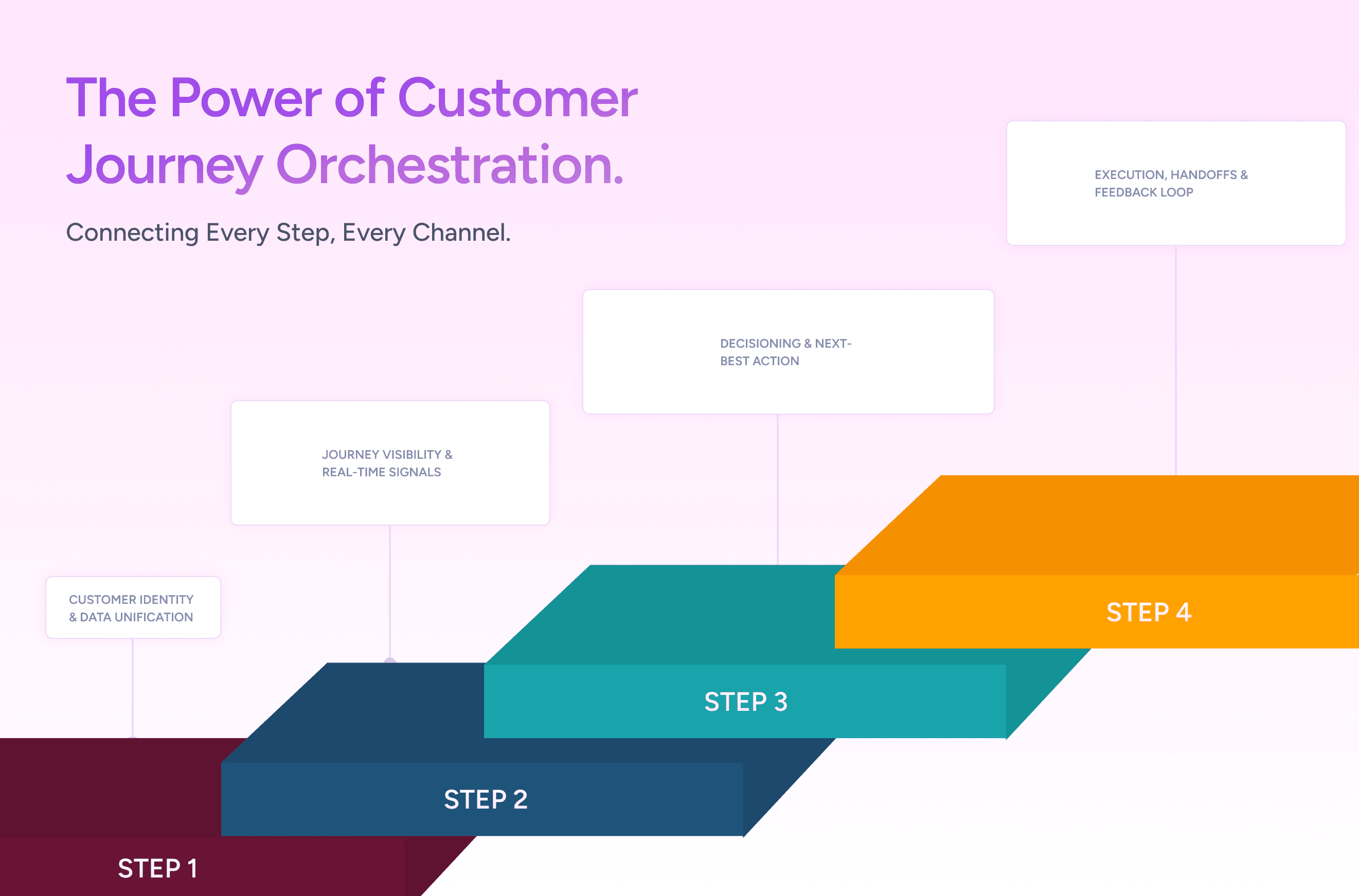
1. They unify customer identity across channels
Not just matching email addresses or phone numbers, but building a living profile that reflects behavior, intent, and history across touchpoints.
2. They decide the next best action in real time
Based on context, not rules frozen in time. The system understands what just happened and what should happen next.
3. They act instantly, without creating noise
Orchestration isn’t about flooding customers with messages. It’s about precision — doing less, but doing it better.
This is where platforms like Ruut stand out.
Where Ruut Fits In
Ruut approaches customer journey orchestration from a fundamentally CX-first perspective.
Instead of treating channels as separate workflows, Ruut connects them into one continuous experience — messaging, chat, voice, automation, and human support all working off the same shared context.
When a customer moves from WhatsApp to web chat, or from self-service to a live agent, Ruut ensures:
Their identity carries over
Their intent is understood
Their history is visible
Their effort is respected
For agents, this means fewer blind conversations and more meaningful ones.
For customers, it means feeling recognized instead of processed.
For businesses, it means lower costs without sacrificing experience.
Ruut doesn’t just automate journeys — it orchestrates decisions, balancing automation and human intervention intelligently.
The Real Impact of Orchestration
When customer journey orchestration is done right, the results are tangible and measurable:
Fewer repeat contacts
Shorter resolution times
Higher first-contact resolution
Reduced operational waste
Happier, more confident agents
Customers who feel known, not handled
From a CX maturity standpoint, this is where organizations move from reactive service to intentional experience design.
Software Isn’t the Win — Strategy Is
Buying orchestration software alone doesn’t solve anything.
The win comes from how orchestration is applied.
The most successful teams don’t try to orchestrate everything at once. They start small and think surgically:
One broken journey
One critical outcome
One clear fix
They clean and connect the right data.
They empower non-technical teams to act on insights.
They design fallbacks for when automation fails — because it will.
Most importantly, they align orchestration with CX principles, not just operational KPIs.
Orchestration Is About Continuity
Customer journey orchestration isn’t about perfection.
It’s not about predicting every move.
It’s not about removing humans from the equation.
It’s about continuity.
In a world where customers zigzag across channels, devices, and moments, continuity is what builds trust. Continuity is what reduces friction. Continuity is what turns interactions into relationships.
Platforms like Ruut make that continuity possible — not by adding more tools, but by making the tools you already rely on finally work together.
And in the end, that’s what great customer experience really is:
Not faster responses.
Not smarter bots.
But a brand that remembers, understands, and responds as one.